
It’s no secret how prevalent social media is in our culture. People as young as toddlers to people as old as senior citizens use it. It can be used for a variety of different purposes, whether it’s for communicating with a friend through Facebook or watching a livestream video on Twitter, social media is ingrained in our daily routines. Perhaps one of social media’s biggest impacts today is through sports, and how sports media has evolved as a result.
Sports media is an ever growing part of entertainment. Fans can communicate, interact with, and be a part of any sport or player that they choose. It’s a way of bringing them closer to the game, without them actually having to be there. While there is no doubt that social media has affected the way that the discourse and news in sports media is delivered and visually displayed, there is perhaps a more impactful result of sports media in our society. I believe this result shows how sports media influences and affects our culture.
Media Literacy
Sports media has many different and unique platforms. Some are used primarily for watching film from games or sports talk shows such as ESPN First Take, Fox’s The Undisputed, The Herd, and many more. Some are used to write messages to players, sport organizations or other fans. For example, many Instagram pages such as Bleacherreport are used for fans to comment on images that display information about a particular sport, and argue with or discuss with other fans. One way that connects all of these platforms and outlets together is how their distribution of information affects their readers/consumers. In a day and age where “fake news” is so widespread, it’s become increasingly more important for fans to decipher between what news is real and what news is hocus or rumors. This leads to the question: how can fans truly decide which media outlet distributes the most accurate information? The short answer is that it’s hard to tell, many outlets have had slip ups from various sources where they have misinterpreted information or delivered false information to the public. One instance of this was seen in earlier this year when two ESPN reporters were clearly not on the same page about a particular trade deal:
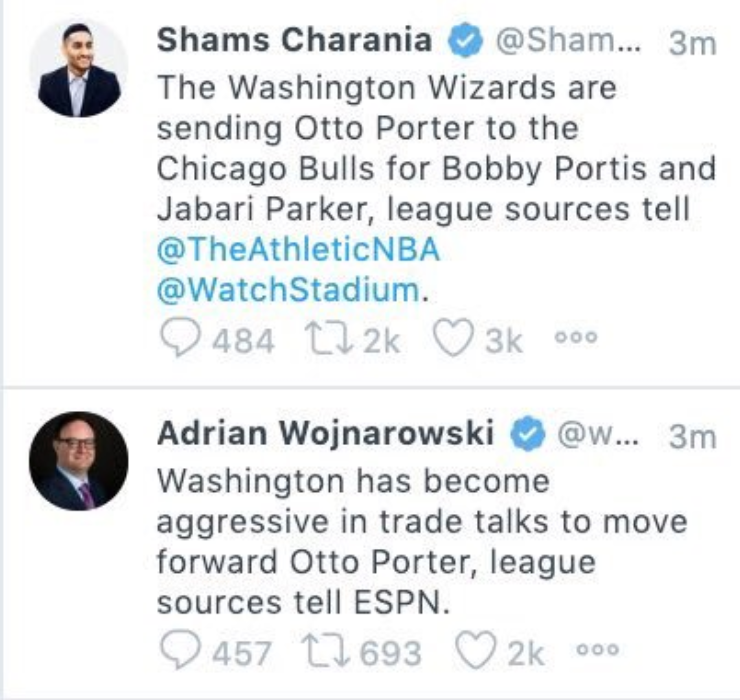
Technically, this is not a thread of inaccurate tweets. It is, however, misleading when a reporter for ESPN tweets about a trade being finalized and immediately afterwards, another reporter also from ESPN tweeting about the possibility of this trade happening. So was Woj just late to the game? Was Shams wrong in his first report? It was difficult to tell at the time, and one can only sit back with a bag of popcorn and watch the event that unfolded on this social media platform.
Our culture suffers as a result of this oversaturation of media. Sports media has led to a need for an increase in every person’s critical thinking and media literacy skills. Otherwise, we will fall victim to the many downsides that have come about when misusing social media and the information that we take from it.
Building Community
Aside from the “fake news” that exists in media, there is another apparent trend in sports social media. Regardless of who you are, sports provides a form of escapism or detachment from reality. Sports can be a way for fans to enjoy being a part of a community, and to come together to move forward following personal or national tragedies that might arise. One exhibition from the 9/11 Memorial & Museum in NYC called Comeback Season: Sports After 9/11 documents the way that sports and teams helped unite fans, New Yorkers specifically, following the attacks on the World Trade Center. They included a brief video outlining the main idea behind the exhibit:
This is undoubtedly a powerful video. It incites emotions not just from sports fans, or even New Yorkers, but Americans as a whole. This was an extremely difficult time for the United States, but this video reminds us all about the sense of Nationalism that we all get from watching sports, and how it can be a way to band together to overcome adversity.
Proximity
Another trend that has emerged in sports and sports social media is the use of footage in sports that goes beyond the game. What I mean by that is that now there are other ways that fans can feel closer to the game without having to be there. This comes in the form of pregame shootarounds, interviews, even team practices. Below I provided a video that displays how close sports media get to athletes in their coverage of them:
Fans can stream these team events through social media in addition to being able to view it on television. Sports media is no longer constrained to showing gameplay alone but can now take a more active approach in showing a player’s and a team’s day-to-day life. This can have both positive and negative effects. On one hand, it establishes a connection with fans and brings them into the fold of who their team is and what they do on a day-to-day basis. On the other hand, it can be an invasion of privacy for the players. There should be a balance struck between media coverage and athlete’s privacy.
Consuming Content
As mentioned before, there are a multitude of platforms that affect the way in which audiences consume media. Twitter, Instagram, Snapchat, Facebook, and Reddit are the main platforms that relay sports media content. Facebook Watch streams show footage of gameplay from a team, Instagram posts pictures of photos taken during a game, and Reddit has channels for fans to converse and interact with one another. These platforms are multipurpose, but also evolving. The use of Twitter in 2009 is vastly different than the use of Twitter in 2019. We are constantly changing the way that we use social media, going beyond the idea that it is simply a tool for communication. Social media is becoming a way that we live our life, whether by gathering information or creating content or some other variation. It affects what we do, and how we do it. I’ve included an infographic on the growing impact of social media related to sports:
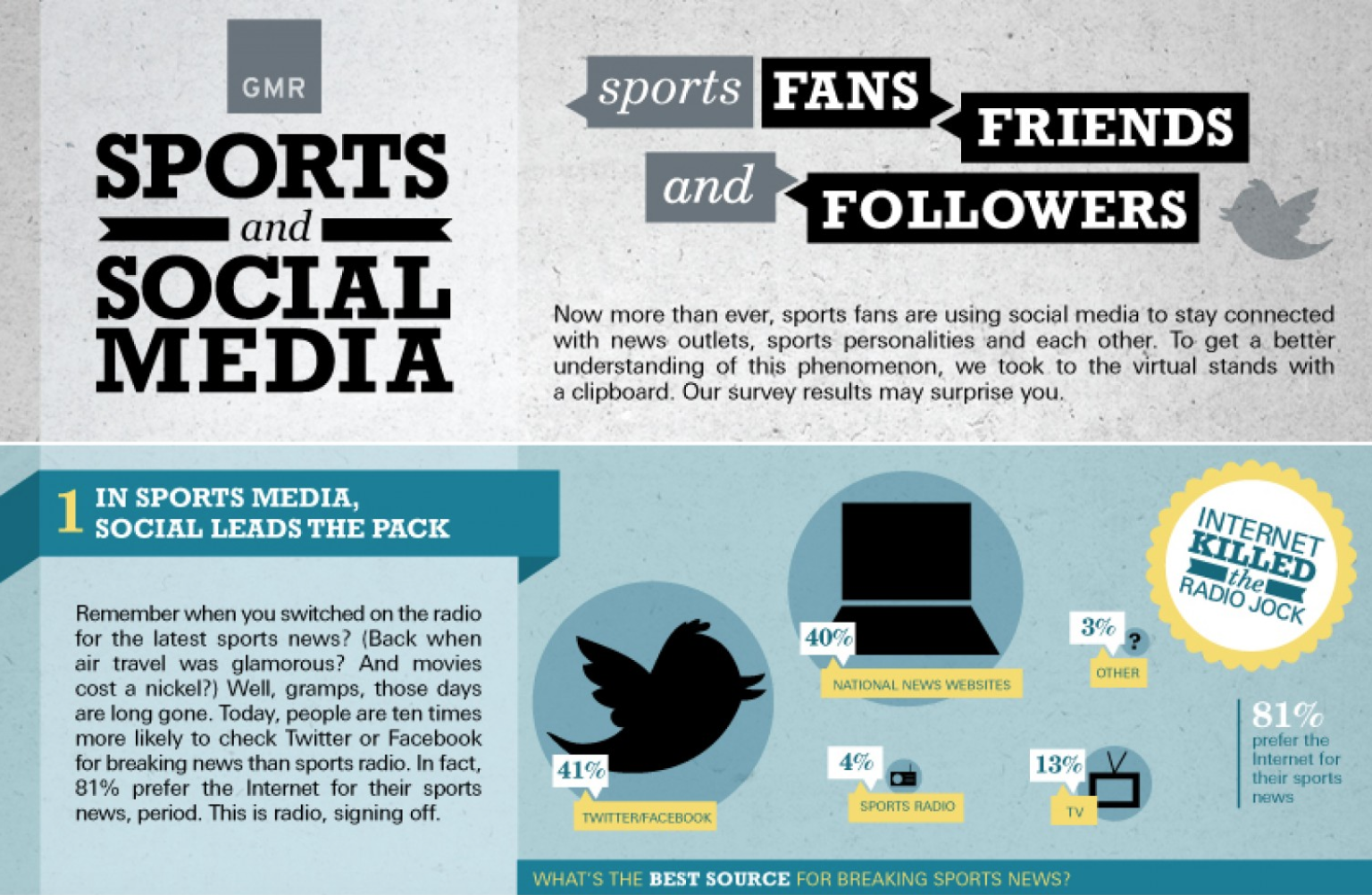
As the above infographic indicates, the majority of people (81%) prefer to get breaking sports news from the internet. While T.V., radio, and other forms of mass communication are viable ways to gather information, it’s clear that social media has taken over as the primary way to consume media. Social media has, quite literally, changed the game.
Sources:
- YouTube. http://www.youtube.com/.
- Billings, Andrew C. Sports Media: Transformation, Integration, Consumption. Routledge, 2014.
- Ahmad, Saad. “Sports and Social Media #Infographic.” Sports and Social Media #Infographic ~, http://www.visualistan.com/2014/03/sports-and-social-media-infographic.html.
 Jack McIntyre's Portfolio